
The Football Number 6: What the Position Means and Who Plays It
The number 6 in football is the deep-lying defensive midfielder — the screen in front of the back line. We explain the role, its evolution, and the modern profile.
 Tap to enlarge
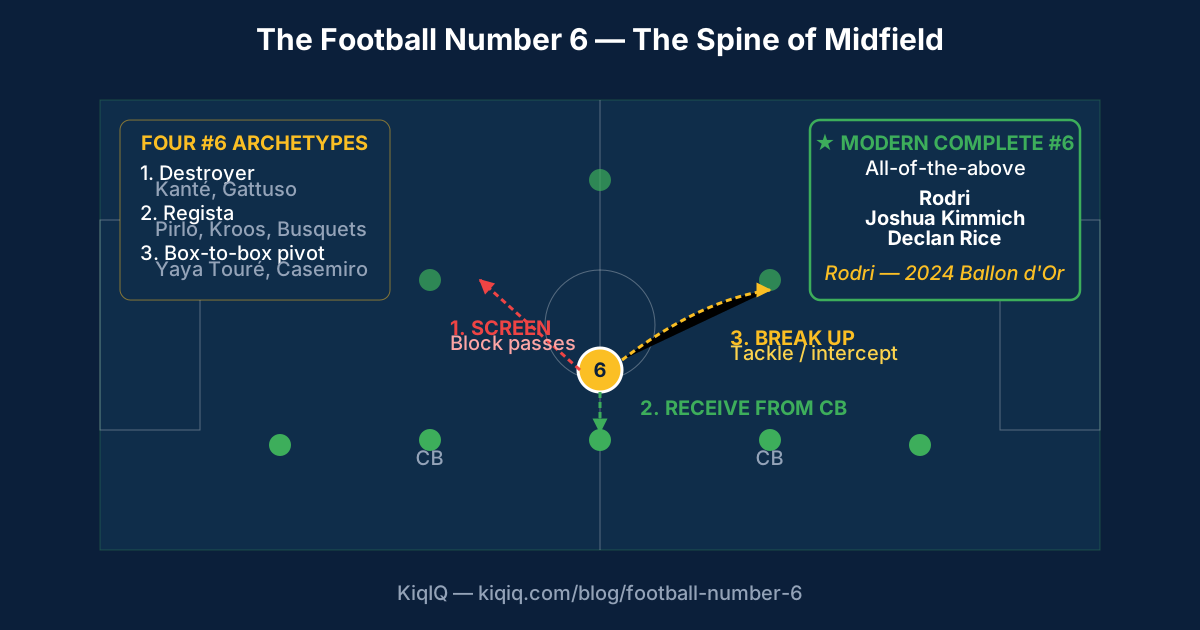
The number 6 in football is the deep-lying defensive midfielder — the player who screens the space between the back line and the rest of midfield. The role evolved from the classic stopper-CB through Pirlo's playmaking #6, the Busquets press-resistant pivot, and now Rodri's complete two-way profile. A great #6 is the spine of any side that wants to control matches.
What the number 6 actually does
The #6 has three core roles, each demanding different skills:
- Screen. Positions in front of the centre-backs to break up opposition passes and prevent through-balls into dangerous zones.
- Receive. Drops to receive from the CBs under pressure, then plays the line-breaking pass forward. Build-up enabler.
- Break up. Wins second balls, intercepts loose passes, fouls when needed (the "tactical foul" stopping a counter-attack).
The four #6 archetypes
Modern football has converged on four distinct #6 profiles:
- Destroyer. Pure ball-winner. Reads passes, intercepts, tackles, but limited passing range. Roy Keane (peak years), N'Golo Kanté (early Chelsea), Gennaro Gattuso. Becoming rarer in modern build-up-focused football.
- Regista (deep playmaker). Press-resistant passer. Receives from CBs, dictates tempo, hits line-breaking diagonals. Andrea Pirlo, Toni Kroos, Sergio Busquets. Dominated 2010s elite football.
- Box-to-box pivot. Combines screening with attacking output. Yaya Touré (peak Manchester City), Paul Pogba (rare flashes), Casemiro at his best. Higher physical demands; rarer profile.
- Modern complete #6. All-of-the-above. Rodri (Manchester City), Joshua Kimmich (Bayern), Declan Rice (Arsenal). The single-position unicorn — destroyer skills + regista passing + box-to-box mobility.
The complete modern #6 is the rarest and most-valuable midfielder profile in football. Rodri's 2024 Ballon d'Or reflected this — he's the prototype.
Try it
How the number 6 evolved
Drag through four generations of the same shirt number.
1. The stopper
A destroyer in front of the back four. The job was to break play up and give the ball to someone better, and nothing else was expected.
The role got harder rather than richer. Each generation added a demand without removing the previous one, which is why elite sixes cost what they cost.
Why the role has become harder
Three pressures have increased the demand on the #6:
- High pressing. Modern teams press the #6 specifically — the keeper plays out, opposition forwards close down on the deep midfielder. Press-resistance is now mandatory.
- Build-up complexity. Inverted full-backs, dropping #9s, and false-9s all require the #6 to recognise and adjust to constantly-shifting positional structures.
- Defensive transition. When possession is lost, the #6 is the first defender between the ball and goal. They must read the threat and either commit to a tackle or buy time for the back-line to set.
How #6 quality is measured
Three statistical signatures of an elite #6:
- Press-resistance metric. Successful pass rate when within 3 metres of an opposition player. Above 80% is elite. Rodri sits at 86%+.
- Progressive passes per 90. Line-breaking passes from a deep position. Top deep-lying playmakers post 7-9 progressive passes per 90.
- Defensive-action zones. A heat-map of interceptions + tackles. Elite #6s show a tight cluster centred just in front of the centre-backs.
- Recovery time. Average seconds from team possession-loss to next defensive action. Elite #6s post 4-5 seconds.
The #6 in different systems
How systems use the #6:
- Single pivot (4-3-3). One #6 sits in front of the back four. Pep Guardiola's base setup at Manchester City — Rodri.
- Double pivot (4-2-3-1). Two #6-types working as a partnership; one usually more defensive, one more progressive. Casemiro + Toni Kroos at Real Madrid.
- Inverted full-back into #6. A full-back tucks centrally to support the lone #6 in possession. João Cancelo did this at City.
- Three at the back system. The #6 has more cover behind, but also more ground to cover horizontally as wing-backs push high.
Famous number 6s in history
Generation-by-generation snapshot:
- Lothar Matthäus — 1980s-90s Germany; box-to-box pivot, 1990 Ballon d'Or.
- Andrea Pirlo — 2000s-10s Italy; the regista template, made deep-lying playmaking glamorous.
- Sergio Busquets — 2008-22 Barcelona; press-resistant possession lung, 3 Champions League winner.
- Xabi Alonso — Liverpool, Real Madrid, Bayern; long-range diagonals, modern coaching career.
- N'Golo Kanté — 2015-22 Leicester + Chelsea; pure destroyer, Premier League title with both clubs.
- Rodri — 2019- Manchester City; modern complete #6, 2024 Ballon d'Or.
- Joshua Kimmich — Bayern; equally elite as RB or #6, complete two-way profile.
- Declan Rice — Arsenal; modern complete #6, late-window summer 2023 transfer at £105m reflected the position's value.
Why your team's #6 is the most important midfielder
If you watch one player on a side that wants to play possession-based football, watch the #6. They touch the ball more than anyone except the goalkeeper. They start every build-up sequence. Their press-resistance dictates whether the team can play out or has to go long. Their reading determines whether transitions are caught or break through.
Manchester City without Rodri were a different team in his injury layoff (2024-25). Real Madrid's pre-Casemiro era and post-Casemiro era look like different teams. The #6 is the spine of the spine.
Frequently asked questions
- What does the number 6 mean in football?
- The number 6 in football refers to the deep-lying defensive midfielder — the player positioned just in front of the back line who screens passes, receives from the centre-backs, and breaks up opposition build-up. It's a positional shorthand from continental European football, distinct from the #4 (typically central defender) and #8 (more attacking midfielder).
- What are the four types of #6 in modern football?
- Destroyer (pure ball-winner like Kanté), regista or deep playmaker (press-resistant passer like Busquets, Pirlo, Kroos), box-to-box pivot (combining screening with attacking like Yaya Touré), and the modern complete #6 (all-of-the-above like Rodri, Kimmich, Declan Rice). The complete #6 is the rarest and most valuable.
- Who is the best number 6 in modern football?
- Rodri (Manchester City) is the consensus pick as of the mid-2020s — he won the 2024 Ballon d'Or as a #6, reflecting his complete two-way profile (press-resistance, progression, defensive output). Joshua Kimmich and Declan Rice are the closest peers. The decline of City when Rodri was injured (2024-25) underlined his individual importance.
- Why is the number 6 so important?
- The #6 touches the ball more than any outfield player and starts every build-up sequence. Their press-resistance determines whether the team can play possession football or must go long. Their reading determines defensive transition outcomes. They're the bridge between defence and attack — a poor #6 breaks both phases of the team.
References
- Number 6: The Evolution of the Defensive Midfielder · The Athletic
- Press-Resistance Metrics · StatsBomb · StatsBomb
- Rodri 2024 Ballon d'Or Profile · The Analyst
- UEFA Coaching Curriculum · Defensive Midfielder · UEFA
Key terms in this article
Ask KiqIQ a follow-up
Get a live, data-driven answer powered by our live data feeds + KiqIQ's Poisson model. Try one of these prompts or write your own.
Part of pillar
Tactical Intelligence
See every article in this knowledge pillar →
Related
Reviewed by a KiqIQ editor before publication. Spotted an error? Email editor@kiqiq.com. We follow our Corrections Policy.