
ADO Den Haag Shirt History: From De Ooievaars to the Modern Era
ADO Den Haag's shirt history: the yellow-and-green identity, the Storks (Ooievaars) connection, the 1970s European nights, manufacturer changes through the 1990s and 2020s.
 Tap to enlarge
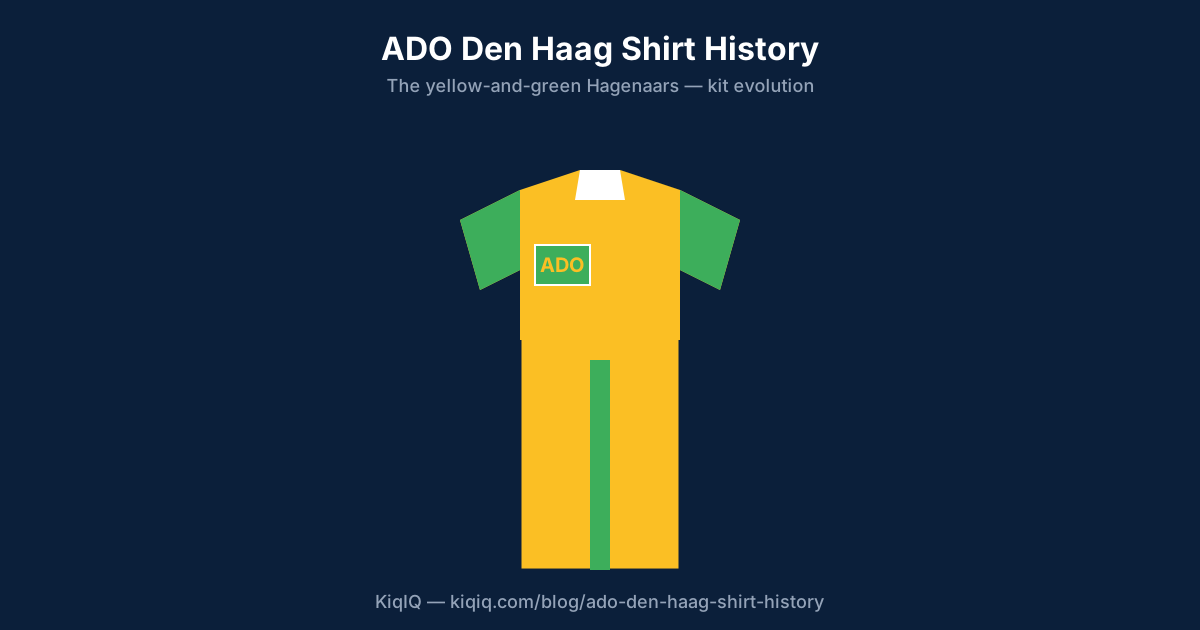
ADO Den Haag's home shirt is one of the most instantly identifiable in Dutch football: yellow and green, almost always in vertical halves, with the city stork on the crest. Founded in 1905 in The Hague (Den Haag), the club, originally ADO and later ADO Den Haag after the 1971 merger with Holland Sport, has carried that colour pairing since its earliest seasons. The kit anchors a club identity that is distinctively Hague rather than nationally generic.
The founding kit and the city stork
ADO (Alles Door Oefening, 'Everything through practice') was founded on 1 February 1905. The yellow-and-green colour scheme is tied to the city of The Hague itself rather than to any commercial origin: the stork on the city's coat of arms appears in yellow on a green field in older heraldic versions, and the club adopted those colours from the start. The Hague has been nicknamed Ooievaarsstad (Stork City) since the medieval period; ADO supporters are De Ooievaars, the Storks, by direct extension.
The vertical-halves layout, yellow on one side, green on the other, has been the default home design across most of the club's history. A representative example is a 2023-24 ADO Den Haag home shirt with the classic split layout, illustrating how the halved colour-block has carried into the modern manufacturer era largely unchanged.
The 1971 merger and the FC Den Haag interlude
In 1971 ADO merged with Holland Sport, a club from the Loosduinen district of The Hague, to form FC Den Haag. The new club retained the yellow-and-green ADO heritage colours rather than adopting Holland Sport's red and black, a decision that preserved the visual continuity of the shirt across the merger. FC Den Haag operated under that name from 1971 to 1996, when the club rebranded back to ADO Den Haag, formally recognising the older identity.
The 1970s FC Den Haag era is the club's strongest competitive period: KNVB Cup wins in 1968 and 1975, and notable European Cup Winners' Cup runs. Shirts from this era often feature the FC Den Haag wordmark and a more vertical-banded layout, sometimes with thinner green panels on a yellow base rather than the symmetrical halves of later eras. Original 1970s match shirts are sought-after items in the Dutch collecting market and rarely appear outside the dedicated retro circuit.
Quick question
What are ADO Den Haag's home colours?
The 1990s template era and Hummel partnership
Through the 1990s the Dutch league entered the full Hummel and Adidas template era. ADO (then still FC Den Haag until 1996, then ADO Den Haag from 1996-97) cycled through several manufacturers, including a long association with Hummel that produced some of the most-collected shirts of the era. The 1990s Hummel ADO templates carry the classic chevron sleeve detailing alongside the yellow-and-green halved torso, a layout that reads well as both a heritage piece and a modern collector item.
Shirt sponsors in this period rotated through regional Dutch and Hague-based businesses. The sponsor logos themselves are part of what dates individual shirts in the eyes of collectors, with mid-1990s editions carrying telecom and food-industry partners and later-1990s editions moving toward energy and insurance branding.
The 1990s halved-yellow-and-green ADO templates with Hummel chevron sleeves are among the most-collected non-elite Eredivisie shirts on the secondary market, alongside Feyenoord and PSV equivalents from the same era.
The Cars Jeans Stadion era and modern manufacturer rotation
ADO Den Haag moved into the Cars Jeans Stadion (originally Aad Mansveld Stadion, then Kyocera Stadion, later renamed for sponsorship reasons multiple times) in 2007. The move coincided with a more consistent return to top-flight Eredivisie football and a sequence of manufacturer changes through the 2010s and 2020s. Each new manufacturer has had to navigate the same constraint: the halved yellow-and-green is sacrosanct, and away kits get most of the experimental design space.
Recent home shirts have stayed close to the historic template: vertical halves, stork crest, modern fan-issue fit with a more athletic cut than the 1990s versions. Away shirts have ranged across black-with-yellow-trim, all-white, and pale-blue variants, all of which give designers freedom to play without disturbing the home identity. The club's relegation and promotion cycle between the Eredivisie and Eerste Divisie has not interrupted the visual continuity.
Specials, anniversaries, and the collector market
ADO Den Haag has marked anniversaries with special-edition shirts that play with the heritage palette. The 2005 centenary edition reproduced a turn-of-the-century crest layout. Several mid-2010s commemorative shirts paid homage to specific 1970s squads. These specials are produced in much smaller print runs than the standard fan issue and circulate primarily through Dutch collectors and the dedicated kit-collecting community rather than wider retail channels.
Outside the Netherlands, ADO Den Haag shirts have a recognisable niche in the broader Eredivisie collector market because the colour scheme is unusual at international level. Yellow-and-green halves do not appear elsewhere in the Dutch top flight and only intermittently across European football. That visual distinctiveness is part of why the shirt has held its market value across decades.
- 1905-1971: ADO. Yellow-and-green halved home shirts from the start, occasional design variations on the green panel width.
- 1971-1996: FC Den Haag. Same colour scheme, slightly more varied vertical layouts; the strongest competitive era.
- 1996-present: ADO Den Haag (restored name). Hummel chevron templates of the 1990s, then a rotation of modern manufacturers.
- Stadium move (2007): Cars Jeans Stadion (formerly Kyocera Stadion) replaces the Zuiderpark; on-pitch consistency tracks the move.
Frequently asked questions
- What colours does ADO Den Haag play in?
- ADO Den Haag plays in yellow and green, typically arranged as vertical halves with one half yellow and one half green. The colour scheme comes from the city of The Hague's coat of arms and stork heraldry, and the club has used it continuously since its founding in 1905, including across the 1971-1996 FC Den Haag era. Away shirts vary across black, white, and pale blue variants depending on the season.
- Why are ADO Den Haag called De Ooievaars?
- De Ooievaars means 'The Storks'. The Hague has been nicknamed Stork City (Ooievaarsstad) since medieval times and the bird features on the city's coat of arms. ADO adopted the stork as the club emblem from its earliest seasons, and supporters have been known as De Ooievaars by direct extension. The crest has been modernised across the decades but the stork has remained central throughout.
- What was FC Den Haag and how does it relate to ADO?
- FC Den Haag was the name used between 1971 and 1996 after ADO merged with Holland Sport. The merged club retained ADO's yellow-and-green colours and the stork identity rather than Holland Sport's red and black. In 1996 the club restored the ADO Den Haag name. The FC Den Haag era includes the club's 1968 and 1975 KNVB Cup wins, its strongest period competitively, and the most-collected vintage shirts.
- When did Hummel produce ADO Den Haag shirts?
- Hummel had a sustained association with the club through parts of the 1990s, producing several of the most-collected ADO Den Haag templates with the classic chevron sleeve detailing. The club has cycled through several manufacturers since, with the home shirt's halved yellow-and-green layout remaining largely untouched across changes. Specific manufacturer dates within the 1990s vary by source; the Hummel templates are the era's most recognised visual signature.
References
- ADO Den Haag, club history page · ADO Den Haag
- Football Shirt Culture Magazine, ADO Den Haag archive · Football Shirt Culture
- Classic Football Shirts, ADO Den Haag editorial archive · Classic Football Shirts
- Museum of Jerseys, Eredivisie design archive · Museum of Jerseys
- ADO Den Haag 2023-24 home shirt, Mystery Shirt Club (affiliate) · Mystery Shirt Club
Key terms in this article
Ask KiqIQ a follow-up
Get a live, data-driven answer powered by our live data feeds + KiqIQ's Poisson model. Try one of these prompts or write your own.
Related
Reviewed by a KiqIQ editor before publication. Spotted an error? Email editor@kiqiq.com. We follow our Corrections Policy.