
4-4-1-1 Formation: The Withdrawn Striker Variant
The 4-4-1-1 modifies a classic 4-4-2 by withdrawing one striker into a deep "second-striker" / 10 role. We cover the structure and how it bridges 4-4-2 and 4-2-3-1.
 Tap to enlarge
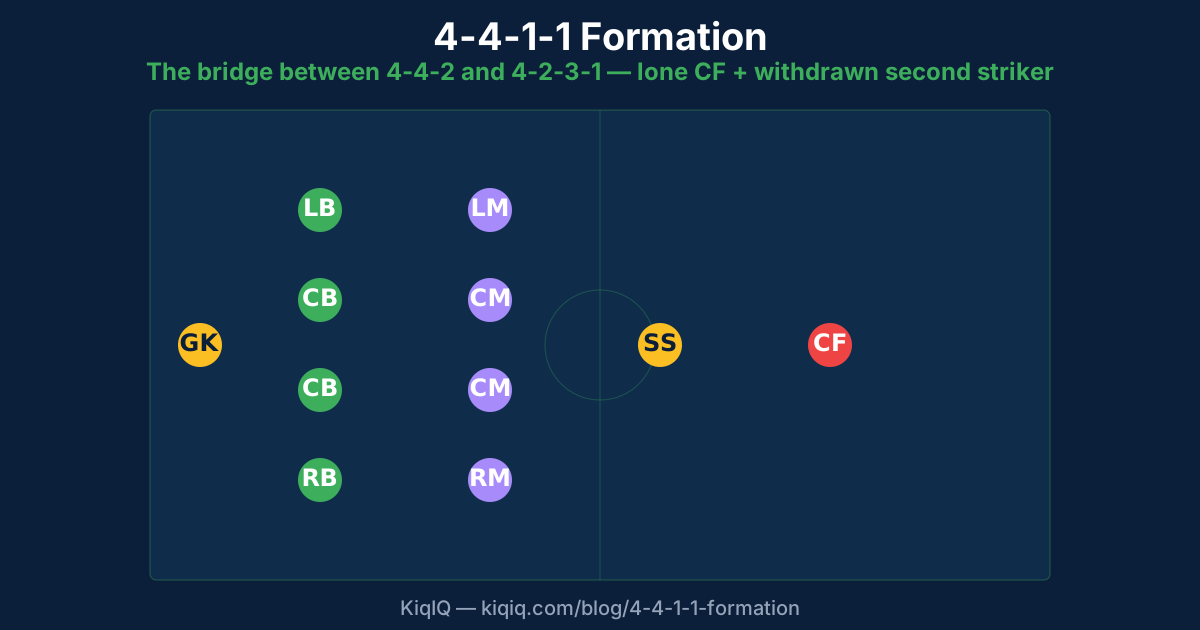
The 4-4-1-1 modifies a classic 4-4-2 by withdrawing one striker into a deep "second-striker" / 10 role between midfield and attack. The structure is functionally a bridge between 4-4-2 and 4-2-3-1 — it keeps the flat midfield four but creates a focal-point creator behind the lone striker.
The 4-4-1-1 structure
- Back four. Standard.
- Flat midfield four. 2 wide mids + 2 CMs.
- Second striker / 10. Withdrawn forward operating between midfield and attack.
- Lone striker. Target / poacher up top.
Try it
The 4-4-1-1 on the pitch
Tap any player to read the role, and use the toggle to compare the shape against its closest relative.
Tap a player to read the role. Currently showing 4-4-1-1, attacking upwards.
A 4-4-2 with one striker dropped ten yards. That small change turns a strike partnership into a link man and gives the midfield a passing option it did not have.
When it works
- Squad has a target striker + a creative 10. Classic example: Crouch + Defoe; Drogba + Lampard advanced.
- Coach prefers 4-4-2 stability. With the small twist of a deeper-second-striker creator.
- As a flexible alternative to 4-2-3-1. When wide players need to be wingers (not wide attackers tucking in).
Strengths + weaknesses
- Strength. Defensive solidity of 4-4-2 + creative depth of 4-2-3-1.
- Strength. Two strikers vertically rather than horizontally — link-up play remains.
- Weakness. The 10 must defend in a flat-mid-4 structure; high workrate required.
- Weakness. Outnumbered in central midfield by 4-3-3 / 4-2-3-1.
Frequently asked questions
- What is the 4-4-1-1 formation?
- 4-4-1-1 is a football formation with 1 GK, 4 defenders, 4 midfielders (flat band), 1 withdrawn second striker / 10 behind the front line, and 1 lone striker. It is a hybrid between classic 4-4-2 and 4-2-3-1.
- How is 4-4-1-1 different from 4-4-2?
- In 4-4-2 both strikers play at the same height. In 4-4-1-1 one striker drops into a deeper "10" / second-striker role between midfield and the lone striker, creating a vertical pair rather than a horizontal one.
- How is 4-4-1-1 different from 4-2-3-1?
- 4-4-1-1 has a flat midfield 4 (2 wide mids + 2 CMs); 4-2-3-1 has a double pivot + 3 attacking midfielders. 4-4-1-1 keeps natural width via wingers; 4-2-3-1 doesn't need wingers because the 3 attacking mids spread wide.
References
- IFAB Laws of the Game · IFAB
- The Coaches' Voice — Formation Library · Coaches' Voice
- BBC Sport · Tactical Coverage · BBC Sport
Key terms in this article
Ask KiqIQ a follow-up
Get a live, data-driven answer powered by our live data feeds + KiqIQ's Poisson model. Try one of these prompts or write your own.
Try the calculators
Apply the concepts from this article with KiqIQ's free calculators.
Part of pillar
Tactical Intelligence
See every article in this knowledge pillar →
Related
Reviewed by a KiqIQ editor before publication. Spotted an error? Email editor@kiqiq.com. We follow our Corrections Policy.