
2-3-5 Formation: The Pyramid That Built Football
The 2-3-5 ("Pyramid") was the dominant football formation from the 1880s to the 1920s. It established the shirt numbers 1-11 we still use. We cover the history and modern revivals.
 Tap to enlarge
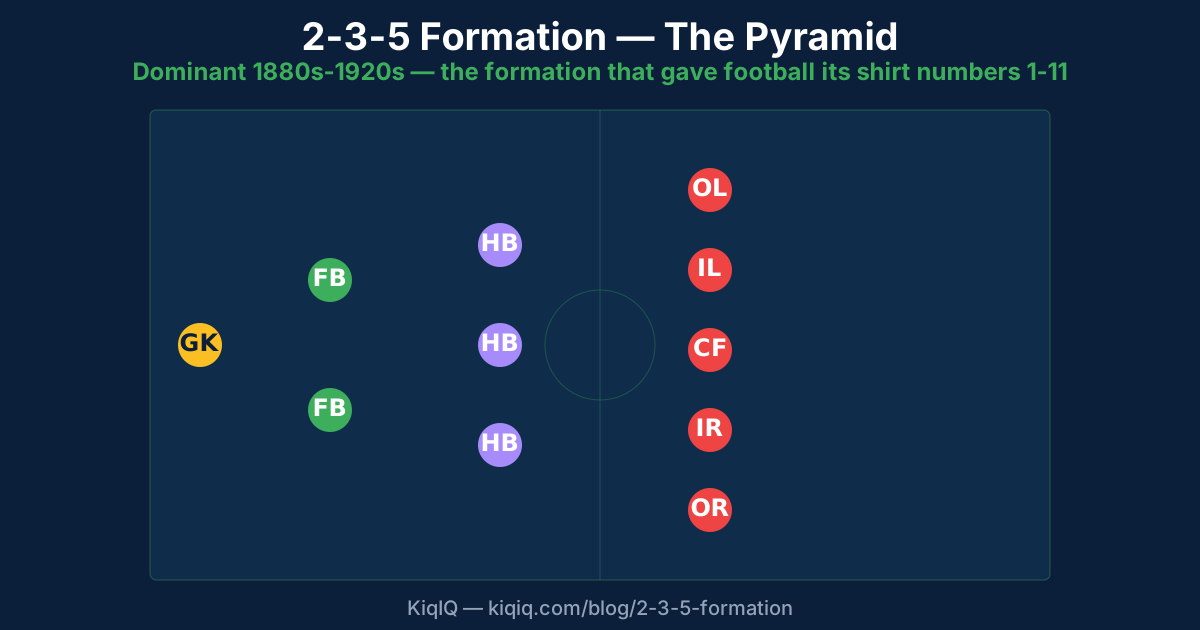
The 2-3-5 — known as "The Pyramid" for its triangular silhouette — was the dominant football formation from the 1880s through the 1920s. It is the formation that gave football the shirt-number system we still use today: 1 GK, 2-3 full-backs, 4-6 half-backs, 7-11 forwards. The 1925 offside-rule change ended its dominance, but echoes appear in modern positional-play systems.
The 2-3-5 structure
- Goalkeeper. Wore the 1.
- 2 defenders (full-backs). Wore 2 (right) and 3 (left).
- 3 half-backs (midfielders). Wore 4, 5 (centre-half), 6.
- 5 forwards. Wore 7 (right-wing), 8 (inside-right), 9 (centre-forward), 10 (inside-left), 11 (left-wing).
- The shirt-number legacy. Modern shirt numbers 1-11 directly trace to 2-3-5 positions, which is why "the 9" still means centre-forward and "the 10" means deep creator.
Try it
The 2-3-5 on the pitch
Tap any player to read the role, and use the toggle to compare the shape against its closest relative.
Tap a player to read the role. Currently showing 2-3-5, attacking upwards.
The pyramid put five men on the last line and two at the back. Toggle to the modern 4-3-3 to see where those five forwards went as the game learned to defend.
Why 2-3-5 dominated 1880s-1920s
- Pre-1925 offside rule. A player needed THREE defenders between them and the goal-line to be onside. With only 2 defenders, attackers had to stay slightly behind the play. 2-3-5 worked under this rule.
- Attack-heavy game. Five forwards meant constant attacking pressure; matches were typically high-scoring.
- International adoption. Used by every major international team and club from Britain through Continental Europe and South America in this era.
Why 2-3-5 disappeared
- 1925 offside rule change. Reduced "three defenders" requirement to "two defenders". This made 2-3-5 vulnerable to attackers running through.
- WM formation rise (1925-1935). Herbert Chapman at Arsenal pulled the centre-half back to create a 3-defender shape (W-M, or 3-2-2-3). WM dominated through the 1930s.
- Tactical evolution. Modern formations all derive ultimately from the WM-era response to 2-3-5's weaknesses.
Modern 2-3-5 echoes
- Pep Guardiola's Manchester City. In peak attacking moments, City's positional structure approximates 2-3-5 with 5 attackers across the front line.
- Modern positional play (juego de posición). Often results in a 2-3-5 attacking structure when full-backs invert and wingers stay high.
- Resurrection theme. Several tactical analysts (Spielverlagerung, The Athletic) have written about modern football "rediscovering" 2-3-5 structures.
Frequently asked questions
- What is the 2-3-5 formation?
- 2-3-5 ("The Pyramid") is a historic football formation with 1 GK, 2 full-back defenders, 3 half-back midfielders, and 5 forwards. It was the dominant formation from the 1880s through the 1920s and is the source of the shirt-numbering system (1-11) still used in modern football.
- Why is 2-3-5 called "The Pyramid"?
- Because the formation's shape on a tactics board forms a triangular pyramid — narrow at the back (2 defenders) and wide at the front (5 forwards). The pyramid silhouette was the formation's defining visual.
- Why did 2-3-5 stop being used?
- The 1925 offside-rule change reduced the requirement from three defenders between attacker and goal to two defenders. This made 2-3-5 vulnerable to attackers running through. Herbert Chapman at Arsenal responded by pulling the centre-half back to create a 3-defender shape (the WM formation), which dominated through the 1930s and pushed 2-3-5 into obsolescence.
- Is 2-3-5 used in modern football?
- Not as a starting formation, but its structure appears in possession-dominant teams. Pep Guardiola's Manchester City in attacking phases often approximates 2-3-5 with full-backs inverting and 5 attackers across the front. Several tactical analysts have written about modern football "rediscovering" 2-3-5 structures.
References
- Wikipedia · Formation (Association Football) · Wikipedia
- Total Football Analysis · Modern 2-3-5 · Total Football Analysis
- IFAB · History of the Laws · IFAB
Key terms in this article
Ask KiqIQ a follow-up
Get a live, data-driven answer powered by our live data feeds + KiqIQ's Poisson model. Try one of these prompts or write your own.
Try the calculators
Apply the concepts from this article with KiqIQ's free calculators.
Part of pillar
Tactical Intelligence
See every article in this knowledge pillar →
Related
Reviewed by a KiqIQ editor before publication. Spotted an error? Email editor@kiqiq.com. We follow our Corrections Policy.