
Selhurst Park: 102 Years of Crystal Palace in South London
From Archibald Leitch's 1924 design to the Holmesdale Road redesign, the South London ground that has hosted three top-flight clubs and remains Crystal Palace's anchor.
 Tap to enlarge
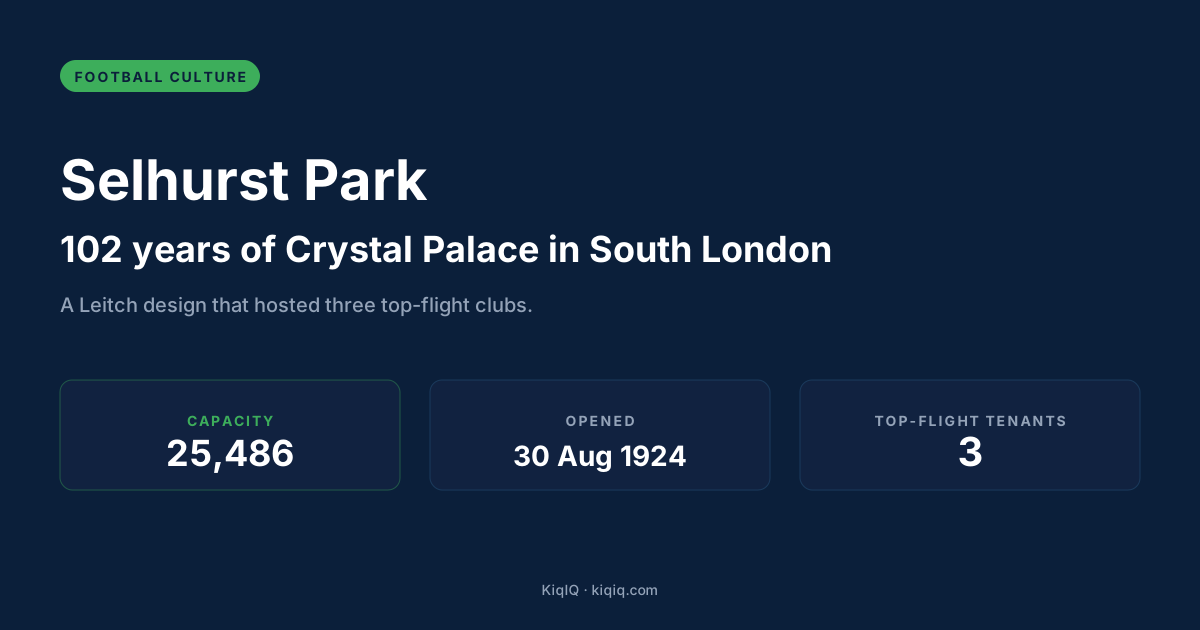
Selhurst Park has been Crystal Palace Football Club's home since 30 August 1924. The ground was designed by Archibald Leitch, the Glasgow engineer whose blueprint defined British football architecture from Ibrox to Stamford Bridge, and is one of the last grounds where any Leitch-era structure remains in match use. The current 25,486 capacity is the result of three major rebuilds: the 1969 Arthur Wait Stand, the 1983 Whitehorse Lane Stand and the 1994 Holmesdale Road Stand. The Main Stand on the eastern side preserves the 1924 Leitch frame, though the seating and roof were modernised in 1995.
The 1924 move and the Leitch design
Crystal Palace played at Crystal Palace Park (the FA Cup Final venue 1895-1914) until 1915, then moved to the Nest in Croydon during the First World War years, before settling at Selhurst Park in 1924. The site was a former brickfield, purchased by the club for £2,750 and developed across two years. Archibald Leitch designed the original ground with a single grandstand on the east side and earth-bank terracing on the other three sides, with capacity initially set at 30,000.
The choice of Leitch was deliberate. By 1924 Leitch had completed stands at Ibrox, Goodison Park, Anfield, Old Trafford and Stamford Bridge, and was the dominant football architect in Britain. His Selhurst Main Stand carried the same pitched-roof, two-tier brick design as his earlier work, though at a smaller scale matching the lower-division club Palace then was. The brick lower-tier facade visible today is the original 1924 structure, now Grade II locally listed by Croydon Council.
The shared-tenancy years
Selhurst Park is the only English football ground to have hosted three top-flight clubs as primary tenants. Crystal Palace have been the permanent tenant since 1924. Charlton Athletic shared the ground 1985-91 after their Valley ground was closed for safety reasons. Wimbledon FC shared the ground 1991-2003 after losing their Plough Lane home, with Wimbledon's "Crazy Gang" era and 1988 FA Cup win staged from Selhurst for their final dozen years.
The shared-tenancy era produced one of English football's most unusual fixture quirks: in March 1992 Crystal Palace played Wimbledon at Selhurst, with the AWAY team's dressing room being closer to the pitch than the home team's. Wimbledon left for Milton Keynes in 2003, and Selhurst Park returned to Crystal Palace as sole tenant. The shared decades left two practical legacies: the ground retains separate "home" and "visitor" badges in places where Palace and Wimbledon had simultaneous claims, and the Whitehorse Lane End was unofficially called "the Wimbledon end" through the 1990s.
Selhurst Park hosted three top-flight clubs as primary tenants between 1985 and 2003 — Crystal Palace permanently, plus Charlton (1985-91) and Wimbledon (1991-2003). No other English ground has matched that.
Quick question
When did Crystal Palace move to Selhurst Park?
The Holmesdale Road rebuild and the modern bowl
The Taylor Report (1990) following Hillsborough required all top-flight grounds to convert to all-seater. Crystal Palace's response was a phased rebuild: the Arthur Wait Stand was upgraded to seating in 1989-91, the Whitehorse Lane Stand was completed as an all-seater in 1983 (ahead of the Taylor requirement), and the major project — the Holmesdale Road Stand — was completed in 1994. The Holmesdale Road Stand's distinctive curved roof, designed by Atherden Fuller architects, gives Selhurst Park its current asymmetric silhouette: a low Main Stand on one side, a tall curved-roof stand at the south end, and uniform mid-height stands at the other two ends.
The current capacity of 25,486 is the lowest of any Premier League ground as of the 2025-26 season. A planned expansion of the Main Stand to a new two-tier 13,500-seat structure was approved by Croydon Council in 2018 and would take total capacity to 34,000+, but the project was paused during the pandemic and has not restarted as of 2026. The Leitch-era 1924 brickwork would be incorporated into the new facade per the heritage-protection conditions Croydon attached to planning approval.
Selhurst Park in modern Premier League culture
Selhurst Park has hosted Premier League football continuously since Crystal Palace's 2013-14 promotion. The Holmesdale Fanatics, the singing section in the Holmesdale Road Stand, are one of the few English club ultras groups with a formal organisational structure, and have produced banner displays and tifos at the standard of Bundesliga or Serie A supporters' groups. Selhurst's acoustic character — the curved Holmesdale roof and the close pitch-to-stand distance — concentrates crowd noise more aggressively than its 25,486 capacity would suggest, with several visiting managers (Pep Guardiola, Jurgen Klopp, Mauricio Pochettino) describing it in post-match interviews as among the loudest grounds they visit.
The South London location also gives Selhurst Park a particular cultural anchor. It is the only Premier League ground south of the Thames, drawing supporters from Croydon, Bromley, Sutton and inner South London in a way no other top-flight club covers. Brick-by-brick scale models capture the asymmetric four-stand silhouette and have become a popular fan gift for Palace supporters in the diaspora.
Frequently asked questions
- When did Crystal Palace move to Selhurst Park?
- 30 August 1924. The ground was built on a former brickfield purchased for £2,750, with the original Main Stand designed by Archibald Leitch. Initial capacity was 30,000 with a single grandstand and three earth-bank terraces. Palace had previously played at Crystal Palace Park (1905-15) and the Nest in Croydon (1915-24).
- Why did Wimbledon and Charlton share the ground?
- Both clubs had safety or planning issues at their own grounds. Charlton Athletic shared Selhurst Park 1985-91 after the Valley was closed for safety reasons. Wimbledon FC shared 1991-2003 after losing their Plough Lane home. Selhurst Park is the only English football ground to have hosted three top-flight clubs as primary tenants.
- What is the current capacity of Selhurst Park?
- 25,486 all-seater across four stands: the Main Stand (eastern side, 1924 Leitch frame with 1995 internals), the Arthur Wait Stand (western touchline, 1969 with 1991 conversion), the Whitehorse Lane Stand (north end, 1983) and the Holmesdale Road Stand (south end, 1994). It is the lowest capacity of any Premier League ground in 2025-26.
- Is there a planned expansion?
- Yes, though paused. A new two-tier Main Stand of 13,500 seats was approved by Croydon Council in 2018, which would lift total capacity to around 34,000. The project was suspended during the pandemic and has not restarted as of 2026. The 1924 Leitch brickwork must be incorporated into the new facade per the heritage conditions attached to planning approval.
- Why is Selhurst Park so loud for its size?
- Two reasons. First, the Holmesdale Road Stand's curved roof concentrates sound downward onto the pitch. Second, the pitch-to-stand distance is among the smallest in the Premier League, with the front row of the Arthur Wait Stand under 10 metres from the touchline. Combined with the Holmesdale Fanatics singing section, the acoustic effect is consistently rated by visiting managers as among the loudest in the league.
References
- Crystal Palace FC: official history of Selhurst Park · Crystal Palace FC
- Engineering a Football Stadium: Archibald Leitch and the Modern Game · English Heritage Press (Jun 2018)
- Croydon Council Local Plan: Selhurst Park heritage designation · Croydon Borough Council
- The Taylor Report on Hillsborough (1990) · HMSO (Jan 1990)
- Wimbledon FC at Selhurst Park: the shared tenancy years · BBC Sport
Ask KiqIQ a follow-up
Get a live, data-driven answer powered by our live data feeds + KiqIQ's Poisson model. Try one of these prompts or write your own.
Part of pillar
Football Culture
See every article in this knowledge pillar →
Related
Reviewed by a KiqIQ editor before publication. Spotted an error? Email editor@kiqiq.com. We follow our Corrections Policy.