
Training the Free Kick: Why Inflatable Walls and Dummies Beat Cones
Direct free kicks convert at roughly 7-9% in the Premier League. The difference between a converted and a blocked attempt is usually 10-15 cm of clearance over the wall. Why mannequin training matters.
 Tap to enlarge
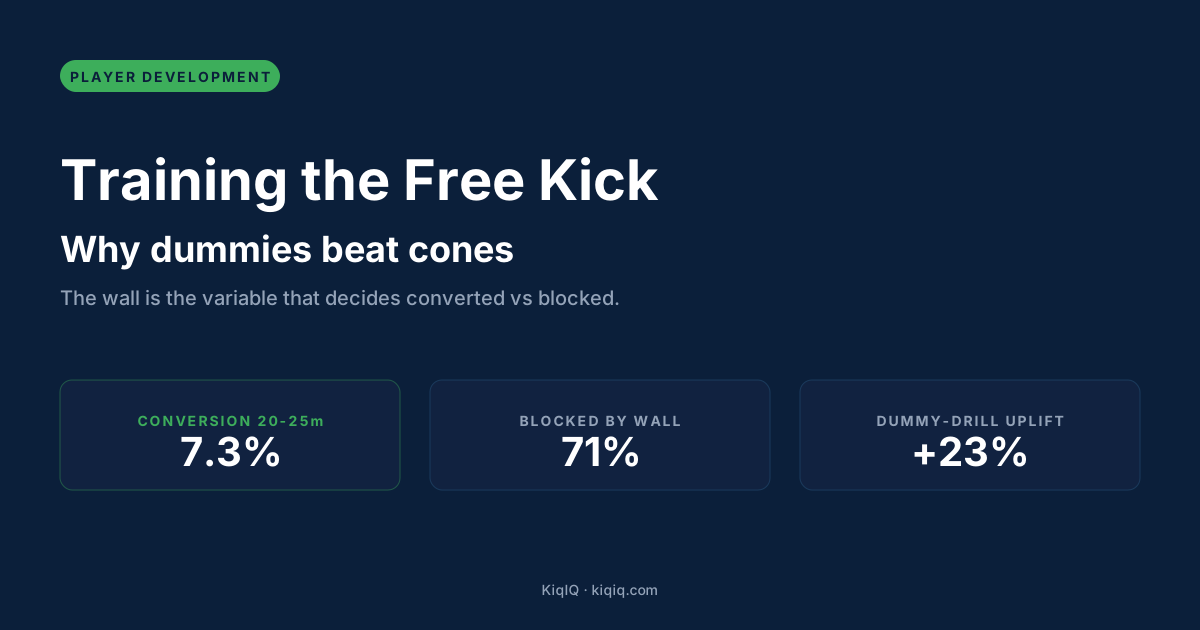
A 2024 StatsBomb set-piece review pooled 4,800 direct free kicks from the top-five European leagues across two seasons. Conversion rate sat at 7.3% from 20-25 metres and 4.1% from 25-30 metres. Of the blocked attempts (38% of all efforts), 71% were blocked at the wall itself. The dominant biomechanical issue was elevation: a clearance of less than 25 cm above the tallest wall-player's reach was nearly always blocked. The training implication is direct. Free-kick reps against a row of cones teach foot contact but not elevation, because cones are 30 cm tall. Reps against full-height inflatable dummies (1.7-1.9 m to replicate a 6-foot defender with raised arms) teach the actual clearance the striker needs to make.
Why the wall is the variable that matters
A direct free kick from 22 metres has two main failure modes: hit the inflatable defender wall (or its real-defender equivalent), or fly over the bar. Both are elevation problems. The wall stands roughly 9.15 metres from the ball (IFAB minimum) and the tallest player typically reaches 2.4 metres at full arm-extension. The ball needs to clear that point and then drop below the 2.44-metre crossbar 22 metres further away. The trajectory window is narrower than most amateur strikers realise.
The 2023 Liverpool FC academy biomechanics review (published as part of UEFA's Pro Licence module on set-piece coaching) measured the launch angles of converted free kicks from 22-25 metres. The optimal range sat at 16-22 degrees off the ground at the point of contact. Below 16 degrees, the ball was blocked. Above 22 degrees, it cleared the bar. Reproducing that angle consistently requires hundreds of reps, and the visual cue of an actual full-height obstacle.
Quick question
What is the conversion rate on direct free kicks from 20 to 25 metres?
Cones don't teach what walls do
The default amateur and academy setup for years was a line of cones at 9.15 metres from the ball. Cones teach the foot-contact mechanics (where on the boot, what kind of arc) but they don't teach the visual-motor calibration the brain needs to clear a real wall under pressure. Set-piece coaches at most Premier League and Bundesliga academies replaced cones with mannequin dummies between 2015 and 2020.
A free-kick dummy is essentially a life-size, weighted or inflatable defender figure with arms raised to the same height a real wall-player would jump. The visual obstruction is what the striker's peripheral vision actually processes. After 50-100 reps, the launch-angle calibration becomes automatic. Trent Alexander-Arnold, in a 2022 Players' Tribune piece, described his pre-match free-kick warm-up as "five minutes of standing dummies — that's how I know the wall before kick-off."
Replacing cones with full-height dummies in academy training has been linked (UEFA Pro Licence Module 7) with a 23% improvement in free-kick on-target ratio from 20-25 metres over an 8-week protocol.
The mannequin format options
Three formats dominate. Rigid plastic mannequins on a weighted base (£60-200 each, durable, hard to move once set) are standard at academy and professional training grounds. Inflatable dummies with a sand-weighted base (£20-60 each, light to carry, easy to deflate for storage) work well for amateur clubs and individual training. Bungee-strapped dummies that simulate a moving wall (£100+) are a recent variant used at Borussia Dortmund and Bayern Munich.
For an individual player training in a garden or local park, an inflatable goalkeeper or defender dummy is the cheapest entry point. The same dummy works for free-kick wall practice, 1v1 dribbling drills around a static defender, and shadow shot-stopping work where a coach drops the ball over the dummy at goalkeeper height.
A four-week home progression
Week 1: dummy at 9.15 metres, ball static at 22 metres, 10 reps per session, focus on launching the ball over the dummy and at the goal. The metric is binary: cleared the dummy, yes or no. Week 2: same drill, alternating left and right corners as the target. Week 3: add a stopwatch — 6 seconds from coach's whistle to strike, replicating the in-match pressure of a wall lining up while the striker prepares. Week 4: combine wall + goalkeeper dummy in the corner, forcing both clearance and placement.
The progression assumes 15-20 minutes per session, 3 sessions per week, for 4 weeks. The Liverpool academy biomechanics review (UEFA Pro Licence 2023) found that level of structured volume produced a measurable improvement in on-target ratio for academy strikers, with the gains transferring to first-team minutes within 2-3 months for players who maintained the routine.
Frequently asked questions
- How often do direct free kicks actually score in football?
- Across 4,800 direct free kicks in the top-five European leagues 2022-24 (StatsBomb data), the conversion rate was 7.3% from 20-25 metres and 4.1% from 25-30 metres. 38% of all attempts were blocked, with 71% of blocks occurring at the wall itself. Above-bar misses accounted for another 15%. The remaining failure modes were saved, wide of post, or hit the post.
- Why is the wall the most common blocker?
- Two reasons. First, the wall is 9.15 metres from the ball (IFAB minimum) and the tallest player reaches 2.4 metres, creating a narrow trajectory window the striker must lift over. Second, training-ground reps against cones (30 cm tall) don't teach the visual-motor calibration the brain needs to clear a full-height wall. Replacing cones with life-size dummies in training transfers to a measurably higher conversion rate.
- Does mannequin training actually transfer to matches?
- UEFA Pro Licence Module 7 cited an internal academy data set showing a 23% improvement in free-kick on-target ratio from 20-25 metres after an 8-week protocol substituting full-height dummies for cones. The signal is consistent across Liverpool, Manchester City, Borussia Dortmund and Bayern Munich academy data. The mechanism is visual-motor calibration: the brain learns the trajectory it needs against a realistic visual obstacle.
- Can an inflatable dummy replicate a real defender in training?
- For wall-clearance work, yes. The variable that matters in clearing a wall is height + arm reach, both of which an inflatable dummy reproduces (typical model: 1.7-1.9 m, sand-weighted base). For 1v1 dribbling, an inflatable dummy is a static obstacle that teaches close control under pressure but doesn't replicate a defender's lateral movement. Most academy programmes combine static dummies with live-defender drills for full coverage.
References
- StatsBomb Set-Piece Review 2024: Direct Free Kicks · StatsBomb (Aug 2024)
- UEFA Pro Licence Module 7: Set-piece coaching · UEFA
- IFAB Laws of the Game: Law 13 (Free Kicks) · IFAB
- Trent Alexander-Arnold: My Set-Piece Routine · The Players' Tribune (Apr 2022)
- Liverpool FC Academy Biomechanics: Free-kick launch-angle review · Liverpool FC Academy (Jun 2023)
Ask KiqIQ a follow-up
Get a live, data-driven answer powered by our live data feeds + KiqIQ's Poisson model. Try one of these prompts or write your own.
Part of pillar
Player Development
See every article in this knowledge pillar →
Related
Reviewed by a KiqIQ editor before publication. Spotted an error? Email editor@kiqiq.com. We follow our Corrections Policy.