
Arsenal Football Club, History, Stadium, Honours, North London
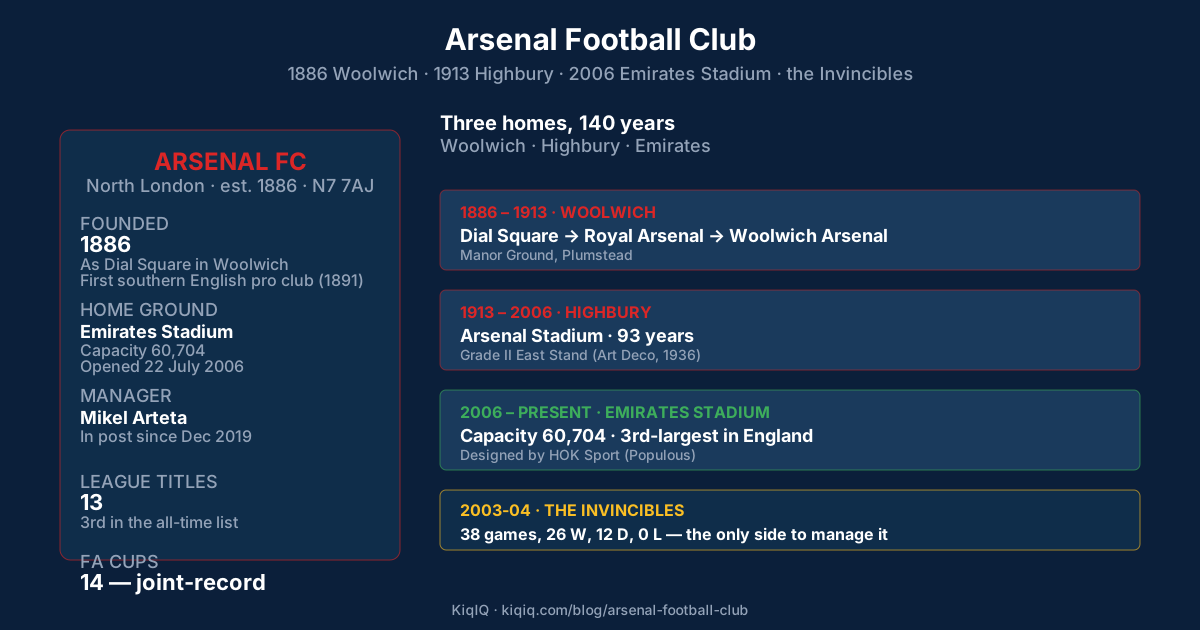
Arsenal Football Club, founded in Woolwich in 1886, plays at the 60,704-capacity Emirates Stadium in north London. The Gunners are joint-record holders of the FA Cup with 14 wins, were unbeaten Premier League champions in 2003-04 (the Invincibles), and contest the North London derby with Tottenham Hotspur.
 Tap to enlarge
Arsenal Football Club is a professional football club based in Islington, north London, founded in 1886 as Dial Square by workers at the Royal Arsenal munitions factory in Woolwich, south-east London. Arsenal play home matches at the Emirates Stadium (capacity 60,704), have been English league champions 13 times, won the FA Cup a joint-record 14 times, and famously went the entire 2003-04 Premier League season unbeaten: the only side to do so over a full 38-game campaign in the modern era. Current manager Mikel Arteta has been in charge since December 2019.
Where is Arsenal Football Club
Arsenal play their home matches at the Emirates Stadium on Hornsey Road in Holloway, Islington, north London (N7 7AJ). The ground sits roughly 500 metres from the club's previous home, Highbury (Arsenal Stadium), where the Gunners played from 1913 to 2006. The closest London Underground stations are Arsenal (Piccadilly Line, directly outside) and Holloway Road (Piccadilly Line, eight minutes' walk).
Although the club is universally identified with north London today, Arsenal's founding home was south of the river: workers at the Royal Arsenal armaments factory in Woolwich formed the club in 1886 as Dial Square. The club was renamed Royal Arsenal, then Woolwich Arsenal, before relocating to Highbury in 1913 under owner Henry Norris, a controversial move at the time, since it brought Arsenal into close geographical conflict with already-established Tottenham Hotspur.
Emirates Stadium · capacity 60,704 · opened 22 July 2006 · home of Arsenal since the 2006-07 season.
A 1886 founding: Dial Square to the Gunners
Arsenal was founded in October 1886 by a group of workers at the Royal Arsenal munitions factory in Woolwich, led by David Danskin, a Scottish factory worker. The original name was Dial Square, after one of the workshops. Within weeks the club had been renamed Royal Arsenal, and by 1891 it had turned professional, the first southern English club to do so, joining the Football League's Second Division in 1893 as Woolwich Arsenal.
The Gunners nickname dates from the founding: a direct reference to the artillery manufactured at the Royal Arsenal. The club's crest has featured cannons in various forms since the early 20th century. The current crest (adopted in 2002) features a single eastward-pointing cannon on a red field, with the wordmark below.
Quick question
What was Arsenal originally called?
The move to north London: 1913
In 1913, under owner Sir Henry Norris, Arsenal moved from the Manor Ground in Plumstead to a new site in Highbury, north London. The relocation was contentious (Tottenham Hotspur, Clapton Orient and other London clubs lodged objections) but Norris saw bigger commercial potential in north London than in the declining Plumstead area.
Arsenal Stadium (Highbury) opened on 6 September 1913 and remained Arsenal's home for 93 years, hosting league matches, FA Cup finals and Wembley-overflow internationals. The Art Deco East Stand, designed by Claude Waterlow Ferrier and William Binnie and completed in 1936, was Grade II listed in 1997 and is now preserved as part of a residential development (Highbury Square) built on the former pitch.
The Emirates Stadium: 2006
Highbury's capacity (38,419 at the end) was unable to keep pace with the club's commercial growth in the Premier League era. Arsenal opened the Emirates Stadium, ~500 metres from Highbury, on 22 July 2006. Capacity: 60,704: the third-largest football ground in England behind Wembley Stadium and Old Trafford.
The Emirates is a bowl-style stadium designed by HOK Sport (now Populous). Naming rights were sold to Emirates Airline in a 15-year, ~£100m deal, at the time the largest stadium-naming deal in football. The deal has been renewed and extended through to 2028 at minimum. Arsenal also play their UEFA fixtures at the Emirates, though European-competition rules require it to be referred to as Arsenal Stadium during UEFA matches because of sponsorship-conflict rules.
Honours: what Arsenal have won
Arsenal are one of the most successful clubs in English football. Their major honours, by competition:
- English league titles: 13: 1930-31, 1932-33, 1933-34, 1934-35, 1937-38, 1947-48, 1952-53, 1970-71, 1988-89, 1990-91, 1997-98, 2001-02, 2003-04. Third in the all-time list behind Manchester United (20) and Liverpool (20).
- FA Cup: 14: joint-record with Manchester United. Most recent win: 2019-20 final vs Chelsea.
- EFL Cup (League Cup): 2: 1986-87 and 1992-93.
- FA Community Shield: 17 (including shared trophies before 1981).
- European Cup Winners' Cup: 1: 1993-94, beating Parma 1-0 in the Copenhagen final.
- Inter-Cities Fairs Cup (UEFA Cup precursor): 1: 1969-70.
- Premier League unbeaten season: 2003-04 only. The "Invincibles" went 38 games unbeaten across the league campaign (26 wins, 12 draws), the only club to do so in a 38-game Premier League season.
The Invincibles: 2003-04
The 2003-04 Premier League season is Arsenal's defining modern achievement. Under manager Arsène Wenger, who had been at the club since October 1996, Arsenal completed the entire 38-game league season unbeaten, 26 wins, 12 draws, 0 losses, 73 goals for, 26 against. Thierry Henry was top scorer with 30 league goals.
The Invincibles squad combined a defensively solid backline (Sol Campbell, Kolo Touré, Ashley Cole, Lauren) with technically gifted attacking midfielders (Dennis Bergkamp, Robert Pirès, Freddie Ljungberg) and a generational forward in Henry. Patrick Vieira captained the side. Preston North End's 1888-89 league title was unbeaten over 22 games; Arsenal's was the first unbeaten English top-flight champions over a 38-game campaign, and remains the only one.
The FA marked the achievement with a specially commissioned golden Premier League trophy, presented at Highbury after the final-day draw with Leicester. The squad is regularly cited as one of the strongest English-league teams of the modern era.
Managers: Chapman, Graham, Wenger, Arteta
Four managers define Arsenal's modern history:
- Herbert Chapman (1925-34). Innovated the WM formation, professional dietary regimes, white sleeves on the home shirt, and the renaming of Gillespie Road tube to "Arsenal", the only London Underground station named after a football club. Won two league titles (1930-31, 1932-33) before his sudden death from pneumonia in January 1934.
- George Graham (1986-95). Won two league titles (1988-89, 1990-91), two League Cups, an FA Cup and the 1994 European Cup Winners' Cup. Tactical disciplinarian, the back four of Adams, Bould, Winterburn and Dixon became one of the most-cited defensive units in English football. Dismissed in 1995 over an undisclosed agent payment.
- Arsène Wenger (1996-2018). 22-year tenure, three league titles (1997-98, 2001-02, 2003-04), seven FA Cups, the Invincibles season, the move to the Emirates, and modernisation of English football's training and dietary culture. Departed at the end of 2017-18 after a long period of declining title contention.
- Mikel Arteta (Dec 2019-present). Former Arsenal captain, returned as head coach in 2019. Won the 2019-20 FA Cup in his first half-season; led Arsenal to second place in 2022-23 (84 points, behind Manchester City) and again in 2023-24. The club's long-term project is structured around Arteta's tactical principles, Edu (sporting director) recruitment, and academy integration.
The North London Derby: Arsenal vs Tottenham
Arsenal's deepest rivalry is the North London Derby with Tottenham Hotspur. The two clubs are based around four miles apart in north London (Tottenham at White Hart Lane / Tottenham Hotspur Stadium, Arsenal at Highbury then the Emirates) and the rivalry has been continuous since Arsenal's 1913 relocation moved them into Spurs' territory.
Across all competitions, the head-to-head sits very close to even, with Arsenal traditionally holding a marginal advantage in league fixtures. The atmosphere on derby day is among the loudest in English football, both grounds historically sell out, the away allocation is small (typically ~3,000), and the build-up dominates north-London media for a fortnight either side.
Honours and notable history
Beyond the headline trophies, Arsenal carry several distinctions worth noting:
- Founding member of the Premier League: one of the 22 clubs that broke away to form the Premier League in 1992-93. Arsenal have spent the entire Premier League era in the top flight; only six clubs share that ever-present status.
- Longest unbeaten league run: 49 games from May 2003 to October 2004, spanning two-and-a-bit Premier League seasons. The run was ended by Manchester United at Old Trafford in October 2004.
- Highbury Art Deco: the East Stand at Highbury is one of the very few football stands ever listed by English Heritage (Grade II, 1997). The frontage survives as a residential development.
- Premier League goals record (single-season): held briefly by Arsenal's 2003-04 side (73 goals) before Manchester City (106 in 2017-18) and others surpassed it. Henry's 30 league goals that season was the joint-highest in a 38-game season at the time.
- Arsenal Women: separate but historically connected; founded 1987, sponsored by the men's club since the early 1990s. The most successful women's club in English football with 15 FA Women's League titles and one UEFA Women's Champions League (2006-07).
How to visit Arsenal
Three practical visit tips:
- Tube. Arsenal station (Piccadilly Line) sits ~50 metres from the Emirates and is the closest. Holloway Road (Piccadilly Line) is the alternative; Highbury & Islington (Victoria Line, Overground) is a 10-minute walk. Arsenal station goes one-way (exit-only) post-match for crowd control.
- Match-day demand. Arsenal's waiting list for season tickets is closed; demand for individual fixtures is consistently high. General-sale availability is rare for high-category fixtures (top-six opponents, Champions League knockouts); membership unlocks ticket access earlier in the sales cycle.
- Tour the Emirates. Self-guided audio tours include the home dressing room, the tunnel and the pitchside, and run most non-match days. Tickets are available via arsenal.com. The on-site Arsenal Museum holds the original trophies and Herbert Chapman memorabilia.
Frequently asked questions
- Where is Arsenal Football Club based?
- Arsenal Football Club plays its home matches at the Emirates Stadium on Hornsey Road in Holloway, Islington, north London (N7 7AJ). The 60,704-capacity stadium has been Arsenal's home since July 2006, replacing the historic Highbury ground ~500 metres away. Arsenal station on the Piccadilly Line is directly outside. Despite the north-London identity, the club was originally founded in Woolwich, south-east London, in 1886, relocating to Highbury under Henry Norris in 1913.
- When was Arsenal Football Club founded?
- Arsenal was founded in October 1886 by workers at the Royal Arsenal munitions factory in Woolwich, south-east London. The original name was Dial Square, after one of the factory workshops. The club was renamed Royal Arsenal within weeks, then Woolwich Arsenal in 1891 when it turned professional, the first southern English club to do so. The current name Arsenal was adopted after the 1913 move to Highbury in north London.
- How many league titles have Arsenal won?
- Arsenal have won 13 English league titles: 1930-31, 1932-33, 1933-34, 1934-35, 1937-38, 1947-48, 1952-53, 1970-71, 1988-89, 1990-91, 1997-98, 2001-02 and 2003-04. That puts Arsenal third on the all-time list behind Manchester United (20) and Liverpool (20). The 2003-04 title is most famous because Arsenal went the entire 38-game Premier League season unbeaten, the Invincibles, still the only side to manage that over a 38-game campaign in the modern era.
- What were the Arsenal Invincibles?
- The Invincibles are the 2003-04 Arsenal squad that completed the entire 38-game Premier League season unbeaten, 26 wins, 12 draws, 0 losses, 73 goals for, 26 against. Managed by Arsène Wenger with Patrick Vieira as captain and Thierry Henry as top scorer (30 league goals), the squad combined defensive solidity (Sol Campbell, Kolo Touré, Ashley Cole, Lauren) with attacking creativity (Bergkamp, Pirès, Ljungberg, Henry). Arsenal's overall unbeaten run reached 49 league games before Manchester United ended it in October 2004.
- Who is the manager of Arsenal Football Club?
- Mikel Arteta has been Arsenal's manager since December 2019. A former Arsenal captain who played for the club from 2011 to 2016, Arteta returned as head coach after serving as Pep Guardiola's assistant at Manchester City. He won the FA Cup in his first half-season (2019-20) and led Arsenal to second place in the Premier League in both 2022-23 (84 points, behind Manchester City) and 2023-24. The club's long-term project is built around Arteta's tactical principles and recruitment under sporting director Edu Gaspar.
References
- Arsenal FC, Official Site · Arsenal FC
- Premier League, Arsenal club page · Premier League
- BBC Sport, Arsenal coverage archive · BBC Sport
- Emirates Stadium, official venue page · Arsenal FC
- Historical English Football League Tables, RSSSF · RSSSF
Ask KiqIQ a follow-up
Get a live, data-driven answer powered by our live data feeds + KiqIQ's Poisson model. Try one of these prompts or write your own.
Part of pillar
Football Culture
See every article in this knowledge pillar →
Related
Reviewed by a KiqIQ editor before publication. Spotted an error? Email editor@kiqiq.com. We follow our Corrections Policy.