
Aberdeen Football Club, Pittodrie, the Dons, 1983 Cup Winners' Cup
Aberdeen Football Club, founded in 1903, plays at Pittodrie Stadium (capacity 20,866) in Aberdeen, Scotland. The Dons are best known for the 1982-83 European Cup Winners' Cup victory over Real Madrid in Gothenburg under Sir Alex Ferguson, the last time a Scottish club won a major European trophy.
 Tap to enlarge
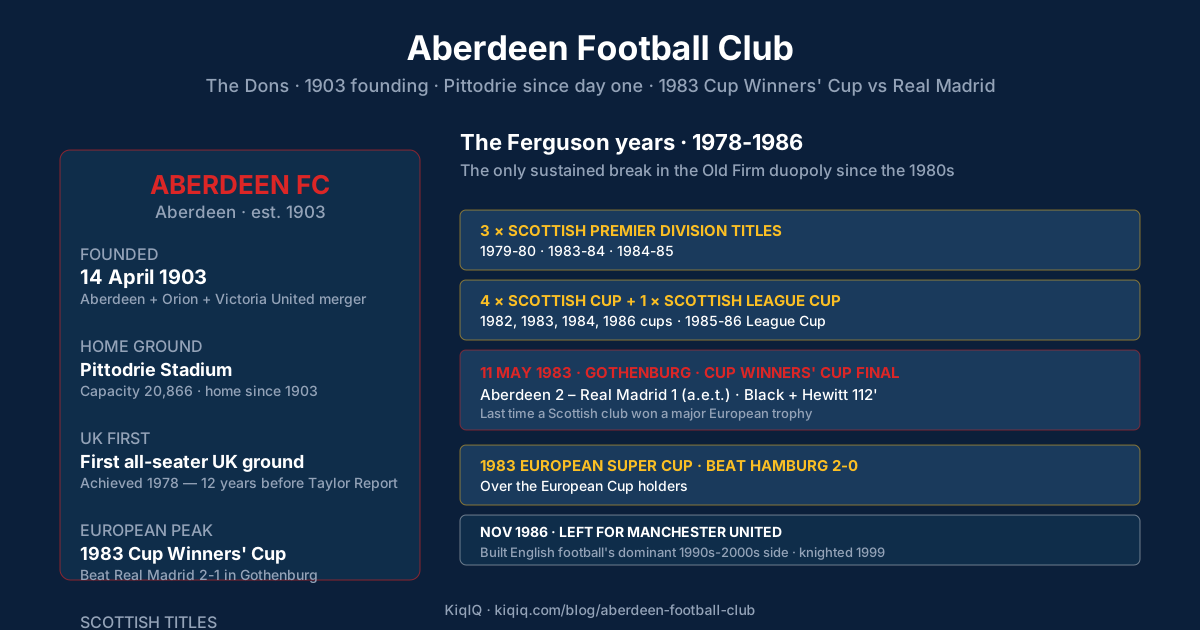
Aberdeen Football Club is a professional football club based in Aberdeen, north-east Scotland, founded in 1903 through the merger of three local clubs. The Dons play at Pittodrie Stadium (capacity 20,866), the first all-seater football stadium in the United Kingdom (achieved in 1978, twelve years before the Taylor Report mandated it). Aberdeen's defining achievement is the 1982-83 European Cup Winners' Cup, won under Sir Alex Ferguson by beating Real Madrid 2-1 in the Gothenburg final: the last time a Scottish club has won a major European trophy.
Where is Aberdeen Football Club
Aberdeen play their home matches at Pittodrie Stadium on Pittodrie Street in the Pittodrie / Linksfield area of Aberdeen, Scotland (AB24 5QH). The ground sits about a mile north-east of Aberdeen city centre, walking distance from the seafront and the city's main beach esplanade.
Pittodrie has been Aberdeen's home since the club's 1903 founding: making it one of the few major British football grounds where the club has had only one home throughout its entire existence. Capacity is 20,866 after the post-1992 all-seater conversion. The club has long-running plans for a replacement stadium at the Kingsford site west of the city, though the timeline has shifted repeatedly.
Pittodrie Stadium · capacity 20,866 · first all-seater football ground in the UK (1978) · home of Aberdeen since 1903.
A 1903 founding via three-club merger
Aberdeen FC was founded on 14 April 1903 through the merger of three local clubs: Aberdeen FC (the original 1881 club), Orion FC (1885), and Victoria United (1889). The merger was driven by the need to consolidate the city's football resources to compete in the Scottish Football League, none of the three predecessor clubs had succeeded individually. The merged club kept the Aberdeen FC name and inherited Pittodrie from the original Aberdeen FC.
The club joined the Scottish Football League Second Division in 1904 and was promoted to Division One in 1905. Aberdeen have been a continuous member of the Scottish top flight since 1905: the longest unbroken top-flight run in Scottish football outside the Old Firm (Celtic and Rangers).
Quick question
How was Aberdeen FC formed?
The 1982-83 European Cup Winners' Cup
Aberdeen's defining moment is the 1982-83 European Cup Winners' Cup. Under manager Alex Ferguson (knighted in 1999), the Dons beat Sion (CH), Dinamo Tirana, Lech Poznań, Bayern Munich, Waterschei, and finally Real Madrid to lift the trophy in Gothenburg on 11 May 1983. Final score: Aberdeen 2, Real Madrid 1 (after extra time), with goals from Eric Black and John Hewitt in the 112th minute.
The Bayern Munich quarter-final was the run's most-cited tie: Aberdeen drew 0-0 in Munich, then beat Bayern 3-2 at Pittodrie in the second leg with Mark McGhee scoring the winner in the 87th minute. The Real Madrid final remains the last time a Scottish club has won a major European trophy.
Ferguson's Aberdeen squad of 1983, Jim Leighton, Willie Miller, Alex McLeish, Doug Rougvie, Stuart Kennedy, Neale Cooper, Peter Weir, John McMaster, Mark McGhee, Eric Black, Gordon Strachan, is widely cited as the strongest Scottish club side outside the Old Firm in the modern era. The same group also beat Real Madrid's continental dominance in an era when European football was unambiguously dominated by Spain, Italy, and West Germany.
The Sir Alex Ferguson era (1978-1986)
Alex Ferguson managed Aberdeen from 1978 to 1986: eight seasons that broke the Old Firm duopoly on the Scottish Premier Division for the only sustained period since the 1980s. Ferguson's Aberdeen won:
- Scottish Premier Division: three titles: 1979-80, 1983-84, 1984-85.
- Scottish Cup: four wins: 1982, 1983, 1984, 1986.
- Scottish League Cup: one win: 1985-86.
- 1983 European Cup Winners' Cup: beating Real Madrid 2-1 in the Gothenburg final.
- 1983 European Super Cup: beating Hamburg 2-0 on aggregate over the European Cup holders.
Ferguson's move to Manchester United and his Aberdeen legacy
Ferguson left Aberdeen for Manchester United in November 1986 and ultimately rebuilt that club into the dominant English side of the 1990s and 2000s. The Aberdeen era is preserved as the foundation of his managerial philosophy: youth integration, work-rate discipline, set-piece dominance, and zero tolerance for senior-player complacency.
Honours and notable history
Aberdeen's major honours and distinctions:
- Scottish Premier Division / Premiership: 4 titles: 1954-55, 1979-80, 1983-84, 1984-85.
- Scottish Cup: 8 wins, most recent 1989-90.
- Scottish League Cup: 7 wins, most recent 2013-14.
- European Cup Winners' Cup: 1: 1982-83 (beat Real Madrid 2-1 in Gothenburg).
- European Super Cup: 1: 1983 (beat Hamburg 2-0 on aggregate).
- First UK all-seater football ground: Pittodrie, achieved 1978.
- Continuous Scottish top-flight membership since 1905: the longest unbroken top-flight run outside Celtic and Rangers.
- Famously the only Scottish club outside the Old Firm to win a major European trophy in the modern era.
How to visit Pittodrie
Three practical visit tips:
- Train. Aberdeen Railway Station is the closest mainline station, about a 25-minute walk along the seafront to Pittodrie or a quick bus from the city centre.
- Match-day demand. Scottish Premiership home games typically run at 13-18k attendance; sell-outs are common for Old Firm visits. The Red Shed (Merkland Stand) is the supporter-singing block.
- Stadium tours. Self-guided and guided tours cover the dressing rooms, the trophy room, the press conference area, and the Sir Alex Ferguson memorabilia. Book via afc.co.uk.
Frequently asked questions
- Where is Aberdeen Football Club based?
- Aberdeen Football Club plays at Pittodrie Stadium on Pittodrie Street in Aberdeen, north-east Scotland (AB24 5QH). The ground has a capacity of 20,866 and has been Aberdeen's home since the club's 1903 founding. Pittodrie was the first all-seater football stadium in the United Kingdom, converted in 1978, twelve years before the Taylor Report mandated all-seater top-flight grounds. The club has long-running plans for a replacement stadium at Kingsford west of the city.
- When was Aberdeen Football Club founded?
- Aberdeen Football Club was founded on 14 April 1903 through the merger of three local clubs: the original Aberdeen FC (1881), Orion FC (1885), and Victoria United (1889). The merger was driven by the need to consolidate Aberdeen's football resources to compete in the Scottish Football League. Aberdeen joined the Second Division in 1904 and have been a continuous member of the Scottish top flight since 1905, the longest unbroken top-flight run outside the Old Firm.
- When did Aberdeen win the European Cup Winners' Cup?
- Aberdeen won the European Cup Winners' Cup on 11 May 1983, beating Real Madrid 2-1 after extra time in the final at the Ullevi Stadium in Gothenburg. Eric Black opened the scoring and John Hewitt scored the winner in the 112th minute. The team was managed by Alex Ferguson (knighted in 1999). The 1983 win remains the last time a Scottish club has won a major European trophy.
- Who managed Aberdeen during their best era?
- Alex Ferguson managed Aberdeen from 1978 to 1986, the most successful era in the club's history. Ferguson won three Scottish Premier Division titles (1979-80, 1983-84, 1984-85), four Scottish Cups, one Scottish League Cup, the 1983 European Cup Winners' Cup, and the 1983 European Super Cup. He left for Manchester United in November 1986 and was knighted in 1999. The Aberdeen era laid the foundation for his managerial philosophy at Manchester United.
References
- Aberdeen FC, Official Site · Aberdeen FC
- SPFL, Aberdeen · SPFL
- BBC Sport, Aberdeen · BBC Sport
- UEFA, 1982-83 Cup Winners' Cup · UEFA
Ask KiqIQ a follow-up
Get a live, data-driven answer powered by our live data feeds + KiqIQ's Poisson model. Try one of these prompts or write your own.
Part of pillar
Football Culture
See every article in this knowledge pillar →
Related
Reviewed by a KiqIQ editor before publication. Spotted an error? Email editor@kiqiq.com. We follow our Corrections Policy.